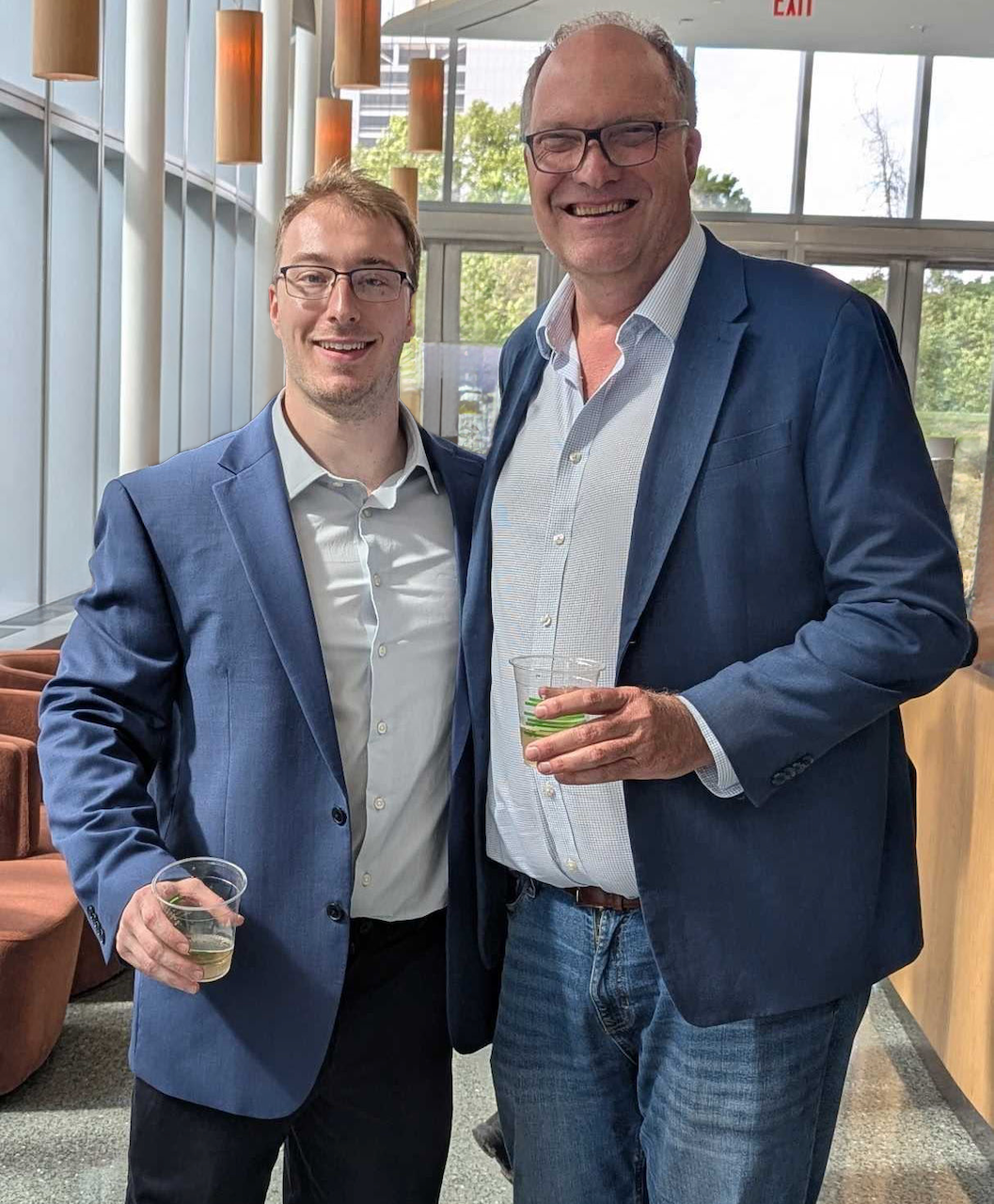
Congrats to Joey Closson for his outstanding PhD defense talk and Q&A on June 18, capping his dissertation work in the GC Ph.D. Program in Biochemistry.
Joey’s dissertation work substantially advanced aspects of the lab’s investigations into the Hypoxia Inducible Factors (HIFs), principally by cryo-EM and biochemical investigations of larger HIF complexes that form on extended DNAs. As reported in his 2026 first author PNAS paper, these longer DNAs which contain both hypoxia response elements (HREs) and nearby sequences – originally first reported over 30 years ago but not well understood – organize larger dimer-of-heterodimer complexes than the simpler ones seen on HREs alone. Such information sheds light on possible gene regulatory mechanisms that could be specific to some HIF-driven genes and not others as a function of HIF levels, as might be seen with HIF-2alpha inhibitors in the clinic. Joey also played important roles in exploring small molecule inhibition of both HIF-2alpha (2024 Protein Science) and ARNT (2024 J. Biol. Chem.) approaches, showing markedly different ways compounds can control Per-ARNT-Sim (PAS) domain structure and function.
More broadly, it’s been a treat having Joey as a member of the lab, particularly in the ways he’s led much of this work while working well with a range of people in the lab and beyond. Special thanks to our collaborators on Joey’s work, including Joe Garcia [Columbia/VA] on the 2026 PNAS paper, and excellent staff & facilities both at the ASRC Structural Biology Initiative (Drs. Eta Isiorho, Denize Favaro, and Rinat Abzalimov) and next door at New York Structural Biology Center for their parts in helping make this all come together!